The Mineral EPIDIDYMITE
- Chemistry: NaBeSi3O7(OH), Sodium Beryllium Silicate Hydroxide.
- Class: Silicates
- Subclass: Inosilicates
- Uses: Only as mineral specimens.
Specimens
Epididymite is yet another classic mineral from agpaites. An unusual igneous intrusive rock that is similar to nepheline-syenites. These rocks are enriched in alkali metals and exotic elements and conversely low in aluminum and silica. Sodium is the chief alkali metal that is present in agpaites and so it is no surprise it is found in epididymite. The beryllium is one of those exotic elements that are in unusual concentrations in agpaites and thus allow minerals like epididymite to form. It is the collector that is rewarded by these unusual rare mineral producing rocks and agpaite deposits are always on the "locality radar" of mineral collectors. Epididymite's locality list is the Who's Who of agpaitic sites. Places like Kola Peninsula, Russia; Mont Saint-Hilaire, Canada;
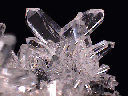
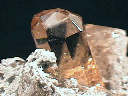
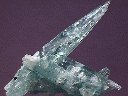
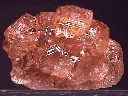
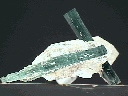
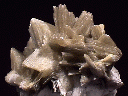
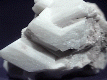
Epididymite forms a wide range of habits and this can lead to confusion in identification. Its most popular habit, which makes for easy identification, is its twin. It forms six sided tabular trillings similar to the classic aragonite twins. The twins are usually cloudy but they are generally well formed. Also fishtail twins are quite interesting as well.
Epididymite gets its name from the Greek words for "near" - epi and "twin" - didymus in allusion to its "near twin", eudidymite. Epididymite and eudidymite are not twins, but dimorphs! Dimorphous minerals are minerals that share the same chemistry, but have different structures. Epididymite's structure is orthorhombic and eudidymite's structure is monoclinic, symmetrically speaking. The best known dimorphs are diamond, (symmetry: Isometric) and graphite, (symmetry: Hexagonal) both of which are made of just carbon.
PHYSICAL CHARACTERISTICS:
- Color is usually white or colorless, but can be pale gray, blue, yellow or violet.
- Luster is vitreous to silky.
- Transparency: Crystals are transparent to translucent.
- Crystal System is orthorhombic.
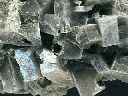
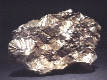
- Crystal Habits include fibrous, acicular and prismatic habits, but more commonly found as tabular, somewhat elongated crystals and aggregate spherulites. Twinning is frequently seen as six sided tabular to columnar trillings and "fishtail" twins.
- Cleavage: is perfect in two directions (basal and prismatic).
- Fracture is splintery to uneven.
- Hardness is 6 - 7.
- Specific Gravity is approximately 2.5 - 2.6 (average for translucent minerals).
- Streak is white.
- Associated Minerals are many and include
nepheline,
aegirine,
pyrite,
sphalerite,
serandite,
eudialyte,
catapleiite,
elpidite,
pyrophanite , astrophyllite, molybdenite, natrolite, siderite, rhodochrosite, calcite, analcime, feldspars, micas and fluorite. - Notable Occurrences include
Kola Peninsula, Russia;
Mont Saint-Hilaire, Quebec, Canada;
Langesundfjord , Norway and Narssarssuk, Greenland. - Best Field Indicators are crystal habit, cleavage, associations, locality and hardness.
 Amethyst Galleries' Mineral Gallery MINERALS |