 |
|
 |
 |
 |
 |
- Chemistry: Be3Al2(SiO3)6, Beryllium Aluminum Silicate
- Class: Silicates
- Subclass: Cyclosilicates
- Uses: Gemstone, mineral specimens and source of beryllium
Specimens - Also see variety specimens:
Aquamarine Specimens Emerald Specimens Goshenite Specimens Heliodor Specimens Morganite Specimens
Other colors of beryl are also used as gemstones but are not as well known.
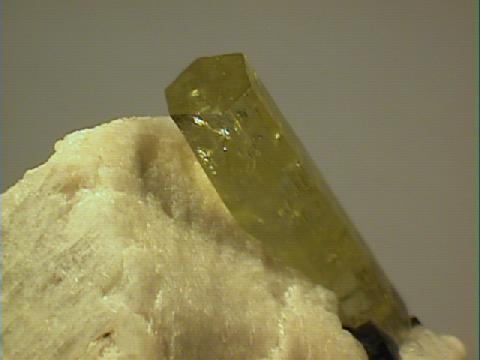
- The greenish-yellow variety is called Heliodor.
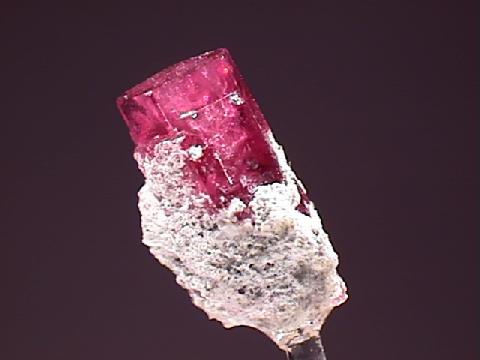
- The pink variety is called Morganite.
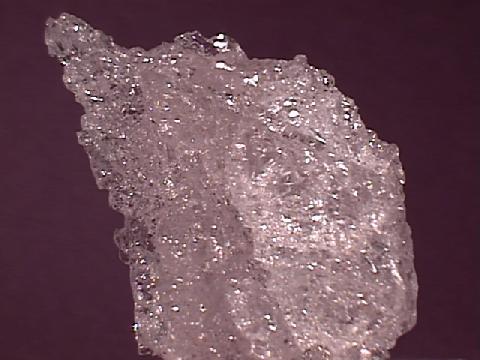
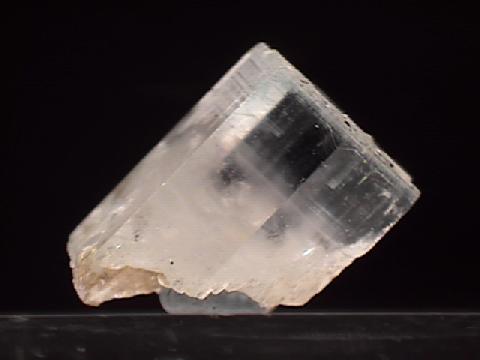
- The colorless variety is called Goshenite.
- The name beryl is used for the red and golden varieties, which are simply called red beryl and golden beryl, respectively.
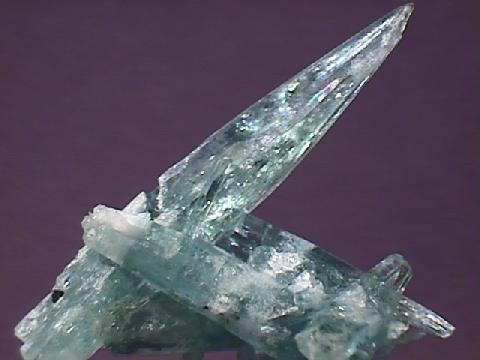
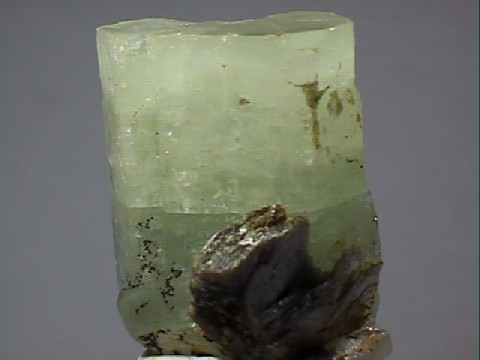
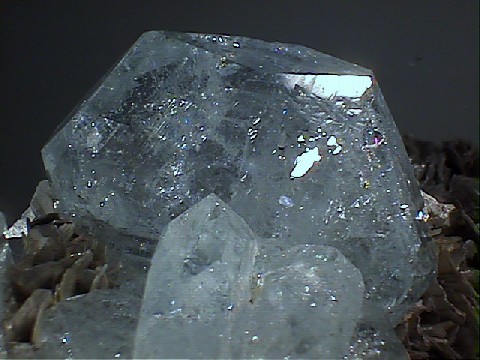
Aquamarine is also a popular gem although it does not command nearly as high a price as its green cousin. Uncut aquamarines are plentiful but relatively expensive, as would be expected of crystalline gemstone specimens. Large crystals of aquamarine are available on the open market and represent perhaps the largest raw gemstone specimens.
PHYSICAL CHARACTERISTICS:
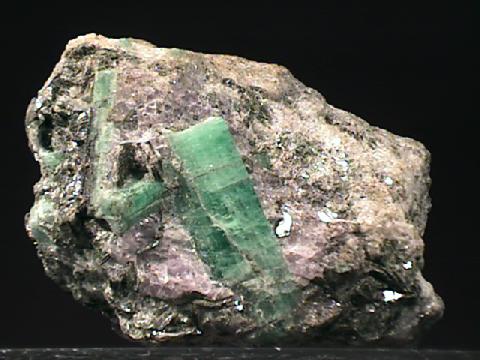
- Color is varied and includes emerald green, blue to blue-green, yellow, greenish-gold, red, colorless and pink.
- Luster is vitreous.
- Transparency: Crystals are transparent to translucent.
- Crystal System is hexagonal; 6/m 2/m 2/m
- Crystal Habits typically include the hexagonal prism with pincoid terminations. The terminations are often modified by many different pyramidal faces which can sometimes produce a rounded termination in the rough shape of a used pencil eraser.
- Cleavage is imperfect in one direction (basal).
- Fracture is conchoidal.
- Hardness is 7.5 - 8.
- Specific Gravity is approximately 2.6 - 2.9 (average)
- Streak is white.
- Other Characteristics: Faces on large crystals are often pitted, striated lengthwise and rough.
- Associated Minerals include micas, quartz, euclase, calcite, tourmalines and some feldspars.
- Notable Occurrences include Colombia and some African localities for emerald; Brazil, Russia and Pakistan for aquamarine; California, Brazil, Africa, and many other localities for other beryls.
- Best Field Indicators are crystal habit, lack of good cleavage, hardness and color.
 Amethyst Galleries' Mineral Gallery MINERALS |
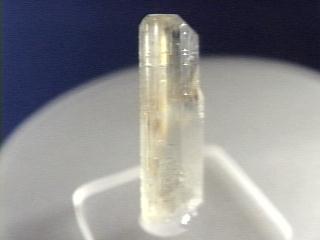
BERYL specimen ber-1
$ 15.00
$ 15.00
Dims: 1-1/8" x 5/8" x 1/4"
Wt: 2 g
Minas Gerais, Brazil
A great value, this little Beryl has a pale yellow color, a perfect termination, and what look like tiny flecks of Mica speckling the upper 1/3 of one side of the crystal. There is an orange inclusion inside of it that runs its entire length. This is an excellent little crystal, and for only $15, you probably won't do any better!
ber-1 ($ 15.00)
Minas Gerais, Brazil
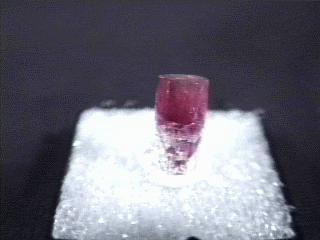
BERYL specimen ber-2
$ 65.00
$ 65.00
Dims: 1/2" x 1/4" x 3/16"
Wt: 1 g
Violet Claim, Wah Wah Mts., Beaver Co., Utah, U.S.A.
One of the rarest varieties of Beryl, this Red Beryl crystal comes from the only locality that produces gem-quality material. This specimen itself is not suitable for a lapidary's workshop, but exhibits excellent crystal form, occurring in the classic hexagonal prism with a clean basal termination, and almost microscopic secondary termination faces. The color is a deep red with a slight violet tint that deepens towards the base. It is translucent, with several visible internal fractures. Its faces are clean and undamaged, showing a vitreous luster.
ber-2 ($ 65.00)
Violet Claim, Wah Wah Mts., Beaver Co., Utah, U.S.A.
BERYL specimen ber-3
$ 60.00
$ 60.00
Dims: 7/16" x 3/16" x 3/16"
Wt: 0.6 g
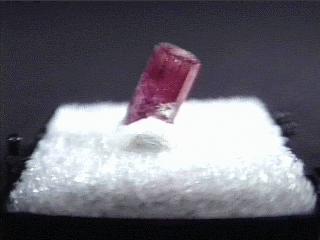
Violet Claim, Wah Wah Mts., Beaver Co., Utah, U.S.A.
Another example of the rarest variety of Beryl, this crystal from the famous Violet Claim has almost perfect form. Its hexagonal prismatic form is most common for beryls, and it has clean sides and a basal termination, with 5 tiny secondary termination faces. One is missing due to a very small amount of damage that actually looks like it occurred prior to its discovery! Its color is a deep red with a violet hint, and is uniform, except for slight fading at the termination area. It is translucent, and has many visible fractures along one angle of its hexagon that run its length. These probably are related to the damaged secondary termination face, and all of this imperfection is likely caused by the formation of a much-fractured "core" of beryl that is visible when one looks straight down at the basal face.
ber-3 ($ 60.00)
Violet Claim, Wah Wah Mts., Beaver Co., Utah, U.S.A.
BERYL specimen ber-4
$ 105.00
$ 105.00
Dims: 1-7/8" x 7/8" x 7/8"
Wt: 17 g
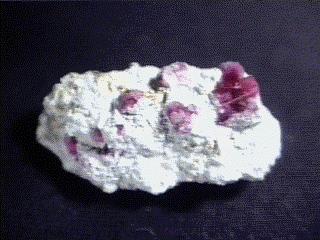
Violet Claim, Wah Wah Mts., Beaver Co., Utah, U.S.A.
There are about 8 definable crystals of Red Beryl in this specimen, among several shards of broken crystals that are embedded in the white, chalky matrix. Those that are complete generally have good hexagonal crystal form and minor damage, if any. Their color is a uniform deep red with a subtle violet highlight, and all are translucent, with enough transparency to see internal fractures and flaws in each. All of them have a vitreous luster on their undamaged faces.
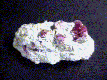
ber-4 ($105.00)
Violet Claim, Wah Wah Mts., Beaver Co., Utah, U.S.A.
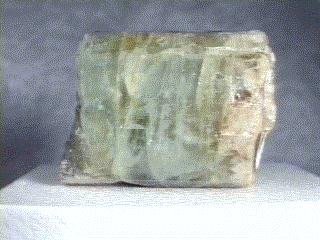
BERYL specimen ber-5
$ 48.00
$ 48.00
Dims: 2-1/2" x 1-5/8" x 1-1/2"
Wt: 6.11 oz
Paris, Maine, U.S.A.
Actually, the color of this particular piece of Beryl says that it is actually the variety called aquamarine, but the paperwork we received with it says "Beryl", so that's what I'll call it. The specimen is made up of an incomplete crystal that has many prism faces, a few of which are interrupted by a broken crystal of a feldspar that has grown into the Beryl. Its color is a pale blue-green that is tinged a dirty red-brown by rust inclusions in several places. It has transparency to a depth of 1/4" in some places, but has intense internal fracturing that, along with the rust inclusions, prevent light from translucing through it at most angles. The break that is closest to the crystal's base looks older than that of the break closest to the termination-- it is weathered and rounded, whereas the other break shows the crystal's uneven fracture and vitreous luster.
ber-5 ($ 48.00)
Paris, Maine, U.S.A.
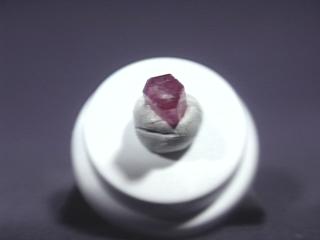
BERYL specimen ber-6
$ 60.00
$ 60.00
Dims: 0.3" x 0.2" x 0.2"(0.8 x 0.5 x 0.4 cm)
Wt: 0.3 g
Violet Claim, Wah Wah Mts., Beaver Co., Utah, U.S.A.
A single Red Beryl crystal constitutes this specimen. It shows a rather large, sloping breakage plane at its base, where it was separated from its place of formation. The hexagonal prismatic crystal shows a complete basal termination, though, and very good form, with clean faces and edges. It has a deep red color with a hint of violet that fades towards the termination, and a vitreous luster. It is transparent and has many veil-like inclusions clustered in the center of its cross-section, stretching along its prism length. These inclusions cloud the center of the crystal, though the material just inside its circumference is quite clear. I have mounted it in a domed plastic thimble box for display.
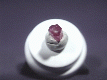
ber-6 ($ 60.00)
Violet Claim, Wah Wah Mts., Beaver Co., Utah, U.S.A.
BERYL specimen ber-7
$ 180.00
$ 180.00
Dims: 2.5" x 1.9" x 0.5"(6.4 x 4.8 x 1.3 cm)
Wt: 1.03 oz.(29.3 g
Violet Claim, Wah Wah Mts., Beaver Co., Utah, U.S.A.
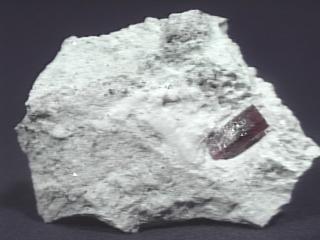
A single hexagonal prismatic Red Beryl crystal is laying parallel to and embedded in the white host rock of this specimen. The visible portion measures 0.5 x 0.3"(1.3 x 0.8 cm), and judging from the thinness of the matrix that it is in, the crystal may not be complete. What is visible does have excellent crystal form, however, with clean prism faces and edges, and an intact basal termination that is mostly buried. Its color is deep red with a hint of violet and its luster is vitreous. Though it is heavily internally fractured and has many veil-like inclusions towards its base, the material near its termination is transparent and surprisingly clear, with only a few thin veils visible. I doubt that there are other crystals hidden in the thin white host rock, which almost reminds me of concrete. I believe that it is a pegmatite of some sort.
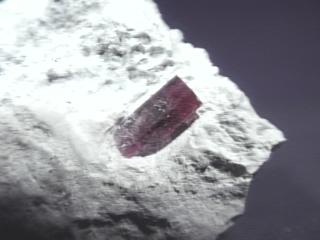
ber-7 ($180.00)
Violet Claim, Wah Wah Mts., Beaver Co., Utah, U.S.A.
BERYL specimen ber-8
$ 180.00
$ 180.00
Dims: 3.9" x 2.4" x 1.2"(9.9 x 6.1 x 3.0 cm)
Wt: 4.03 oz.(114.3 g)
Violet Claim, Wah Wah Mts., Beaver Co., Utah, U.S.A.
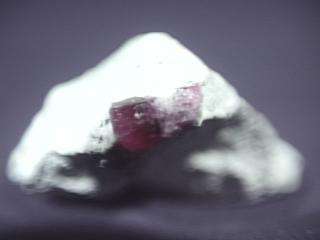
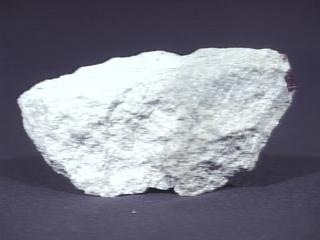
This specimen is made up of a large but definitely incomplete red Beryl crystal that is partially embedded in a white, cement-like host rock. Estimates put its dimensions at 0.6"(1.5 cm) long and 0.3"(0.8 cm) in diameter. The visible parts of the crystal have excellent hexagonal prismatic form with a definable basal termination. Its color is a deep red tinged with violet and it has a vitreous luster. The color is deepest towards the center of the prism, so it is my guess that this crystal grew out in both directions from the center. The end that has the visible termination seems to be transparent, though clarity is interrupted by many veil-like inclusions and a few internal fractures. It rests on the end of a rather sizable chunk of host rock- there is a chance that other crystals could be found inside this rock. I would personally use a dilute hydrochloric acid on it.
ber-8 ($180.00)
Violet Claim, Wah Wah Mts., Beaver Co., Utah, U.S.A.
BERYL specimen ber-9
$ 230.00
$ 230.00
Dims: 3.4" x 1.8" x 1.0"(8.6 x 4.6 x 2.5 cm)
Wt: 3.00 oz.(85.2 g)
Violet Claim, Wah Wah Mts., Beaver Co., Utah, U.S.A.
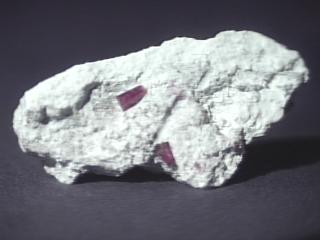
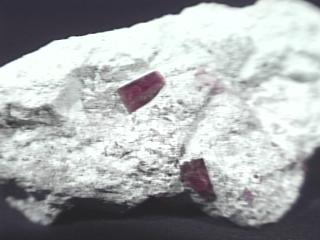
This specimen contains one of the finer Red Beryl crystals that I have seen, partially buried in a white host rock. Though it is small(estimated dimensions- 0.3"(0.8 cm) long and 0.2"(0.5 cm) in diameter), it is probably complete, with excellent hexagonal prismatic form and basal terminations on each end. Its color is a deep red with a hint of violet, its luster is vitreous, and it is definitely transparent, though many internal fractures destroy its clarity. There are many fragments of other crystals nearby, though none show any crystal form. A bit of careful work with a dental pick could free up a bit more of the complete crystal for viewing.
ber-9 ($230.00)
Violet Claim, Wah Wah Mts., Beaver Co., Utah, U.S.A.
 BERYL specimen ber-10
$ 320.00
Dims: 4.0" x 2.2" x 1.8"(10.2 x 5.6 x 4.6 cm)
Wt: 7.24 oz.(205.3 g)
Violet Claim, Wah Wah Mts., Beaver Co., Utah, U.S.A.
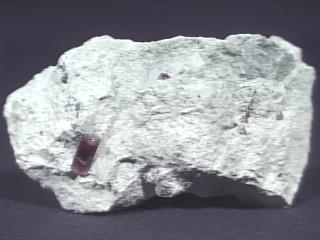
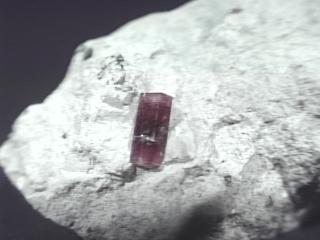
This specimen contains the finest Red Beryl crystal that I have seen for its size. It is at least 50% exposed, and rests parallel to the white host rock's surface. The visible portion is undamaged and has near-perfect hexagonal prismatic form with a basal termination on each end. The faces and edges are clean, showing a vitreous luster. The crystal's color is a deep red with a violet tinge that is deepest at the center of its prism length, fading towards both terminations. It is transparent and shows good clarity that is uniform throughout the crystal, though internal fractures are visible and are especially concentrated near one of the terminations. There is one other crystal, only a small part of which is visible, that is waiting for somebody to expose it. Parts of two prism faces and one termination face are visible, with a tiny, conchoidal chip in the termination. Judging by the large size of the host rock, there may well be other crystals buried in this mass. It is a fine specimen.
 ber-10 ($320.00)
Violet Claim, Wah Wah Mts., Beaver Co., Utah, U.S.A.
BERYL specimen ber-11
$ 45.00
$ 45.00
Dims: 2.1" x 1.2" x 1.1" (5.3 x 3.0 x 2.8 cm)
Wt: 1.75 oz.(49.7 g)
Violet Claim, Wah Wah Mts., Beaver County, Utah, U.S.A.
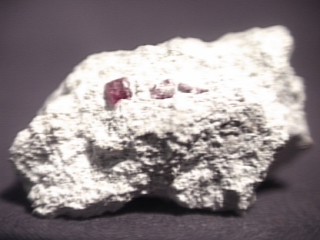
A few small Red Beryl crystals rest in the white host rock of this specimen. The visible portions of the crystals do not exceed 0.2" (5 mm) in length, but have good hexagonal prismatic form and basal terminations. They have a deep violet-red coloration and a vitreous luster, and the largest one is noticeably transparent, though some internal fractures and cloudy inclusions interfere with the clarity. Other crystals on the specimen may be larger, but are less exposed- one is obviously broken. A small amount of careful work with a dental pick could free up more of these crystals for examination.
ber-11 ($ 45.00)
Violet Claim, Wah Wah Mts., Beaver County, Utah, U.S.A.
BERYL specimen ber-12
$ 32.00
$ 32.00
Dims: 0.2" x 0.1" x 0.1" (0.5 x 0.3 x 0.2 cm)
Wt: 8.4 g w/ specimen box
Violet Claim, Wah Wah Mts., Beaver County, Utah, U.S.A.
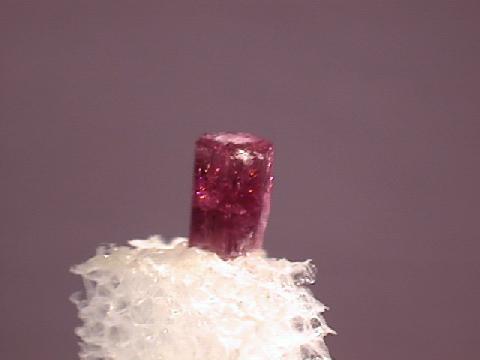
Though it is pretty much a micromount as far as size is concerned, this tiny crystal is quite beautiful, and in very good condition. It has the standard hexagonal prismatic form with a basal termination, and shows a bright, vitreous luster. Its has a deep red color with a hint of violet and is transparent near its termination, but clouds towards its base, which is missing some material along two prism faces. There are several inclusions or internal fractures visible in the clear part of the crystal; I cannot determine which. It is isolated, and no host rock or other material is present. The crystal is glued onto a small foam "platform" inside a plastic specimen box.
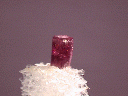
ber-12 ($ 32.00)
Violet Claim, Wah Wah Mts., Beaver County, Utah, U.S.A.
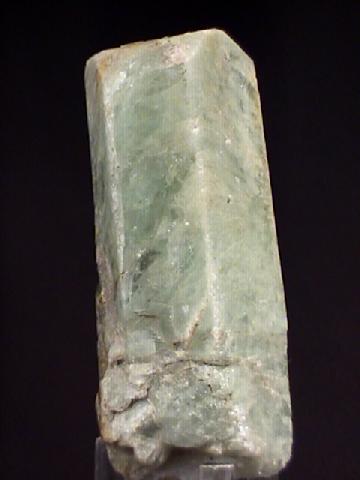
BERYL specimen ber-13
$ 75.00
$ 75.00
Dims: 4.2" x 1.7" x 1.4" (10.7 x 4.3 x 3.6 cm)
Wt: 11.8 oz. (335 g)
Paris, Maine, U.S.A.
This rather large hexagonal prismatic Beryl crystal could almost be called an aquamarine, but its color is not quite blue enough. It is in good condition, though there is some visible damage to edges on the terimination and along the prism. Its form, however, is very good, with well-defined edges and clean faces that show a rather dull vitreous to an almost waxy luster in areas. The termination is complete but somewhat malformed, as its basal face is slightly angled and its secondary faces are very much asymmetrical. It has a pale green color and shows substantial rust-staining. Though there are areas of substantial clarity visible along its prism faces, the crystal is essentially only dimly translucent. There is a small amount of foam still glued to its base, bu
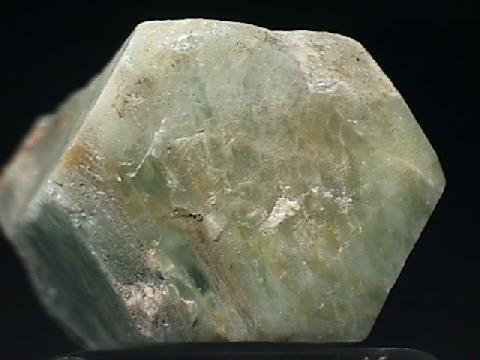
ber-13 ($ 75.00)
Paris, Maine, U.S.A.
BERYL specimen ber-14
$ 28.00
$ 28.00
Dims: 0.3 x 0.3 x 0.1" (0.8 x 0.8 x 0.3 cm)
Wt: 8.9 g w/ specimen box
Thomas Range, Juab, Utah, U.S.A.
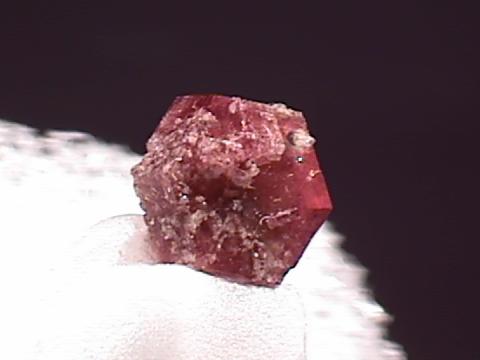
This small thumbnail specimen consists of a cluster of 4 intergrown Red Beryl crystals. Only one of these crystals is complete, and it is much larger than the others, making up almost all of the bulk of the specimen. All are in excellent condition, showing almost no visible damage, and have excellent and rather unusual hexagonal tabular form. Their edges are quite well defined and their faces are relatively clean and possess a pearly luster. They have the standard deep raspberry-red coloration of Red Beryl and are translucent, showing patches of noticeable transparence. There is no host rock present, and the specimen has been set into a plastic specimen box for display.
ber-14 ($ 28.00)
Thomas Range, Juab, Utah, U.S.A.
BERYL specimen ber-15
$ 48.00
$ 48.00
Dims: 0.6 x 0.3 x 0.3" (1.5 x 0.8 x 0.8 cm)
Wt: 9.7 g w/ specimen box
Thomas Range, Juab, Utah, U.S.A.
A single crystal of Red Beryl projects from the host rock of this tiny thumbnail specimen. It actually consists of two intergrown crystals, but they are intergrown enough to be considered a single unit. It has dimensions of 0.3 x 0.2 x 0.2" (8 x 6 x 5 mm) and is in excellent condition, as it appears to be undamaged. It has excellent hexagonal prismatic form, with well-defined edges and clean basal termination and prism faces that possess the standard vitreous luster. Its color is a deep violet-red and it is dimly transparent due to considerable internal fracturing and the presence of cloudy inclusions. There is only a small amount of the pale, chalky host rock present, and the piece has been mounted in a plastic specimen box for display.
ber-15 ($ 48.00)
Thomas Range, Juab, Utah, U.S.A.
BERYL specimen ber-16
$ 30.00
$ 30.00
Dims: 1.9 x 1.2 x 0.9" (4.8 x 3.0 x 2.3 cm)
Wt: 1.06 oz. (30.2 g)
Violet Claim, Wah Wah Mountains, Beaver County, Utah, U.S.A.
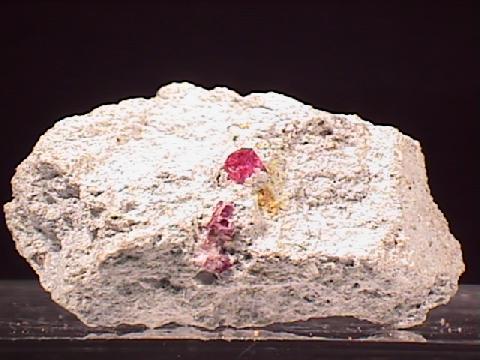
A single, tiny Red Beryl crystal rests in the chalky, gray-white host rock of this thumbnail specimen. It does not exceed 0.1" (3 mm) in either length or diameter, and is in good condition, showing only a small amount of damage. Its hexagonal prismatic form is excellent, capped by a basal termination. Its edges are well-defined and its faces are clean, possessing the standard vitreous luster. Its deep red coloration with a hint of violet is also standard for this variety of Beryl, and it appears to be transparent and at least partly clear. It does contain noticeable inclusions and internal fractures, however. There are a few broken bits of other crystals nearby on the host rock.
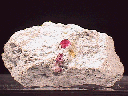
ber-16 ($ 30.00)
Violet Claim, Wah Wah Mountains, Beaver County, Utah, U.S.A.
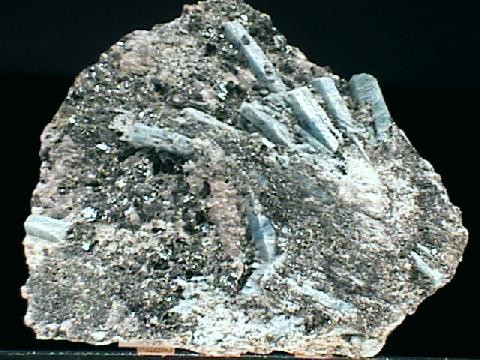
BERYL specimen ber-17
$ 33.00
$ 33.00
Dims: 4.2 x 3.8 x 0.8" (10.7 x 9.7 x 2.0 cm)
Wt: 9.29 oz. (263.5 g)
Inyo Mountains, Lone Pine, California, U.S.A.
Several pale blue Beryl crystals rest in the pegmatite host rock of this specimen. These crystals reach lengths of at least 1.2" (3 cm) and are in fair condition, as all appear to be damaged and missing their terminations. Most of the damage appears to have occurred prior to mining, however. All have excellent hexagonal prismatic form, with well-defined edges and clean faces where they are intact. They are only dimly translucent at best and possess a rather dull pearly luster. The pegmatite host in which they rest is made up of fine feldspar grains that are cemented together along with larger pieces of nearly crystalline quartz, and countless tiny books of biotite.
ber-17 ($ 33.00)
Inyo Mountains, Lone Pine, California, U.S.A.
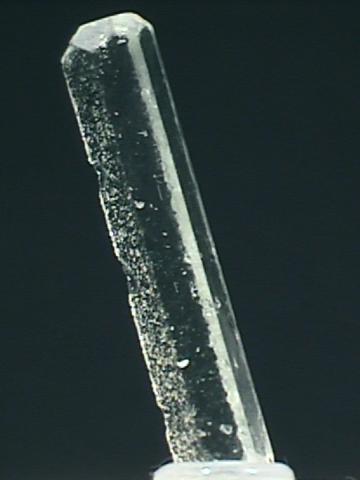
BERYL specimen ber-18
$ 60.00
$ 60.00
Dims: 1.4 x 0.3 x 0.2" (3.6 x 0.8 x 0.5 cm)
Wt: 7.1 g w/ base
Minas Gerais, Brazil
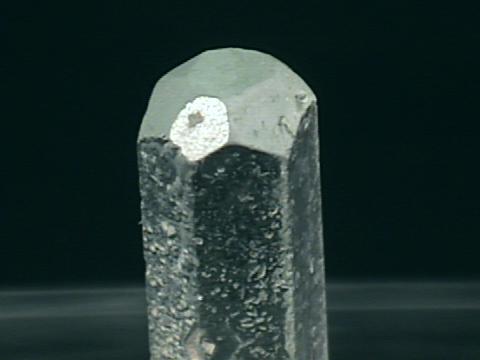
A single Beryl crystal comprises this specimen. It is in excellent condition, showing only a few very tiny spots of damage, and has exceptional hexagonal prismatic form, topped by a complex domed termination. Its color is a very pale green and its luster is pearly-to-vitreous. It is transparent and extremely clear- so clear, in fact, that one can look through its primary termination face, down through the crystal, through the hot glue that attaches it to its base, and through the base itself to clearly read small print underneath!
ber-18 ($ 60.00)
Minas Gerais, Brazil
BERYL specimen ber-19
$ 25.00
$ 25.00
Dims: 3.5 x 2.5 x 2.0" (8.9 x 6.4 x 5.1 cm)
Wt: 13.9 oz. (394 g)
Minas Gerais, Brazil
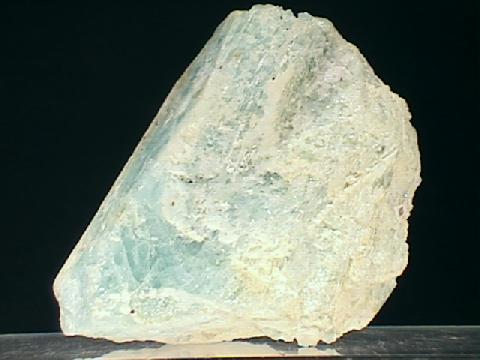
This large hand specimen consists of a broken and weathered portion of a large Beryl crystal. Though it is mostly incomplete, it does have portions of all 6 prism faces, so its hexagonal cross-section is evident. It could be considered an aquamarine due to its pale blue color, and its undamaged faces show a dull pearly luster. It is translucent and heavily internally-fractured. Bits of broken albite are embedded in it, but there is no host rock present.
ber-19 ($ 25.00)
Minas Gerais, Brazil
BERYL specimen ber-20
$ 150.00
$ 150.00
Dims: 5.4 x 4.3 x 3.0" (13.7 x 11.0 x 7.7 cm)
Wt: 2 lbs., 8.6 oz. (1.152 kg)
Royal Gorge area, Fremont County, Colorado, U.S.A.
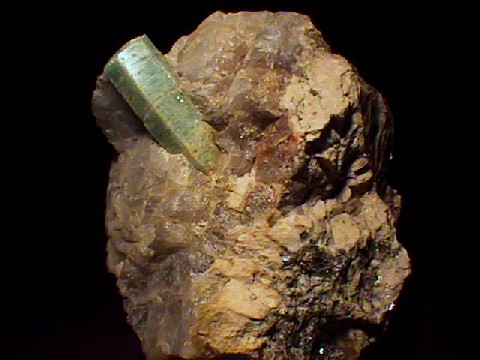
Five hexagonal prismatic Beryls are embedded in the pegmatite host of this large display piece. Though all are missing natural terminations and most show some fresh damage, they are generally in good condition. The longest of them is rather thin but measures nearly 4" (10 cm) in length. All have obvious and very good hexagonal form. Their aqua-green color is not quite blue enough to be considered aquamarine, and all have a vitreous luster. All are also transparent, but so intensely internally fractured that their clarity is nonexistent. The pegmatite in which they rest contains the standard quartz, muscovite and feldspar.

ber-20 ($150.00)
Royal Gorge area, Fremont County, Colorado, U.S.A.
BERYL specimen ber-21
$ 25.00
$ 25.00
Dims: 2.4 x 1.6 x 1.0" (6.0 x 4.0 x 2.6 cm)
Wt: 4.4 oz. (124 g)
Bumpus Mine, Albany, Maine
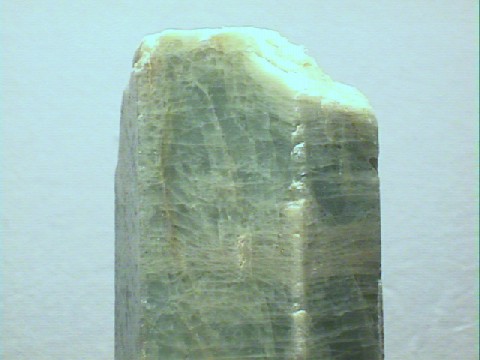
This hand specimen consists of a single Beryl crystal that is in excellent condition - it shows very little damage. Its hexagonal prismatic form is likewise excellent, and it has a standard basal termination. Its color is a dull blue-green, its luster is pearly at best and it is effectively opaque, containing countless internal fractures and flaws. There is no host rock present, and the piece was collected in 1969 and was part of the William Schultz Collection.
ber-21 ($ 25.00)
Bumpus Mine, Albany, Maine
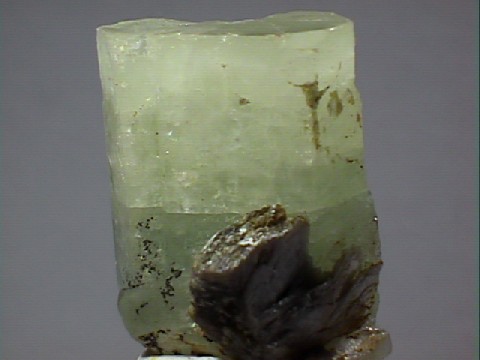
BERYL specimen ber-22
$ 45.00
$ 45.00
Dims:1.2x1.0x0.9" (3.0x2.5x2.3 cm)
Wt: 0.8oz. (22g)
Orlovskoe Mine, Aginskoe, Russia
This is an excellent twinned crystal of beryl. One side of the specimen shows moderate damage, but the twin plane is clearly visible on the other side of the crystal. This specimen shows a basal pinacoid termination. A bit of muscovite matrix material is attached to one side.
ber-22 ($ 45.00)
Orlovskoe Mine, Aginskoe, Russia
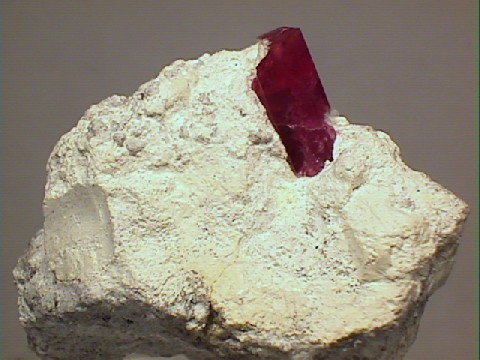
BERYL specimen ber-24
$ 240.00
$ 240.00
Dims:1.5x1.2x0.9" (3.8x3.0x2.3 cm)
Wt: 0.7oz. (20g)
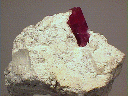
Violet Claim, Wah Wah Mountains, Beaver cty., Utah
A single crystal of red beryl protrudes from the altered rhyolite matrix of this specimen. This crystal measures nearly 0.5" (1.3cm) in length, and shows good translucency. There is a chip missing from the crystal at the termination.
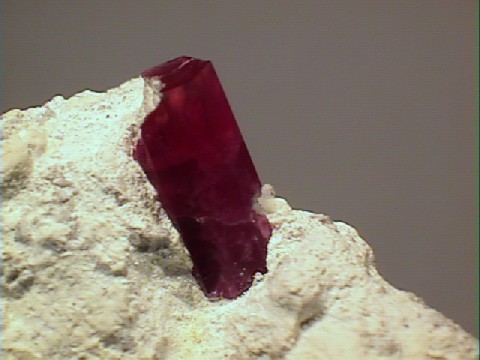
ber-24 ($240.00)
Violet Claim, Wah Wah Mountains, Beaver cty., Utah
BERYL specimen ber-25
$ 115.00
$ 115.00
Dims:1.7x0.9x0.7" (4.3x2.3x1.8 cm)
Wt: 0.4oz. (12g)
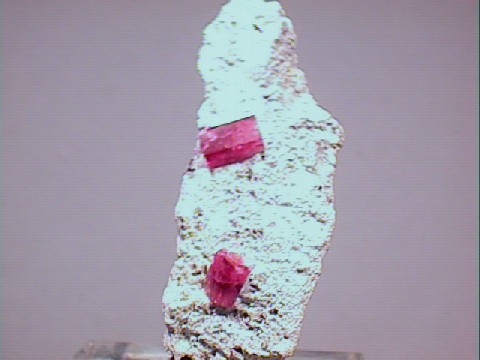
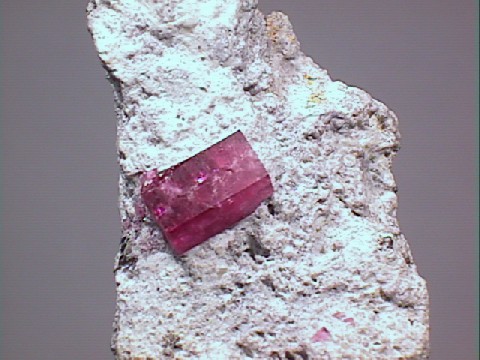
Violet Claim, Wah Wah Mountains, Beaver cty., Utah
Two crystals of red beryl rest on a matrix of altered rhyolite in this specimen. The larger of these crystals measures 0.2" (0.5cm) in length. Both of these crystals have flat basal terminations, and show at least some translucency. There are only a couple of very tiny nicks on these crystals.
ber-25 ($115.00)
Violet Claim, Wah Wah Mountains, Beaver cty., Utah
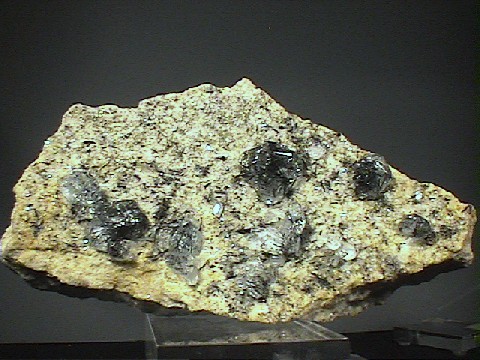
BERYL specimen ber-26
$ 60.00
$ 60.00
Dims: 4.5x2.5x0.9" (11.4x6.5x2.3 cm)
Wt: 6.1 oz. (173 g)
Zhaoton, Sichuan Provence, China
This hand specimen of beryl is a bit too clear and colorless to be called aquamarine, although it shares the crystal shape of some very nice Chinese aquamarine that I have seen. There are perhaps two dozen crystals, some of which are intergrown, on the surface of the quartzite base. There are also numerous needls of schorl tourmaline, including many schorl needles growing through the beryl. Much of the appeal of this specimen is due to the radiating tourmaline inclusions in the otherwise extremely transparent beryl crystals, which are undamaged.
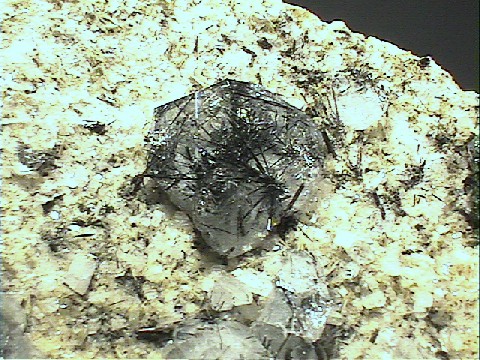
ber-26 ($ 60.00)
Zhaoton, Sichuan Provence, China
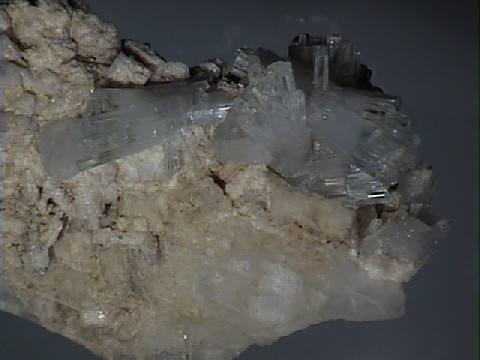
BERYL specimen ber-27
$ 130.00
$ 130.00
Dims: 2.93x2.04x1.15" (7.45x5.19x2.91cm)
Wt: 2.94oz (83.1g)
Goshent, Pakistan
This is a nice specimen of beryl - it shows several clusters of long prismatic crystals, many doubly terminated, as bundles on a matrix that looks like albite. The tips of the crystals are clear and nearly colorless, so they are properly "goshenite", although the bases are milky white. The face of the specimen is covered with a large transparent crystal (about 4mm thick and without natural edges), that looks similar to the beryl, but I believe that it is a different (unidentified) mineral.
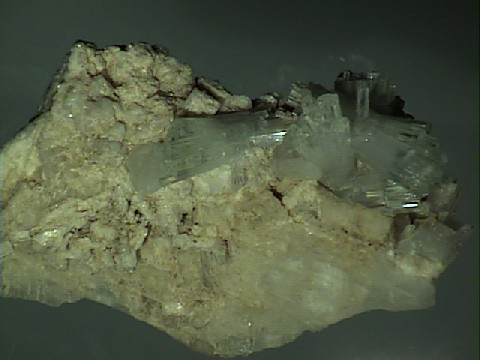
ber-27 ($130.00)
Goshent, Pakistan
BERYL specimen ber-28
$ 40.00
$ 40.00
Dims: 4.26x2.32x1.65" (10.83x5.90x4.19cm)
Wt: 10.32oz (292g)
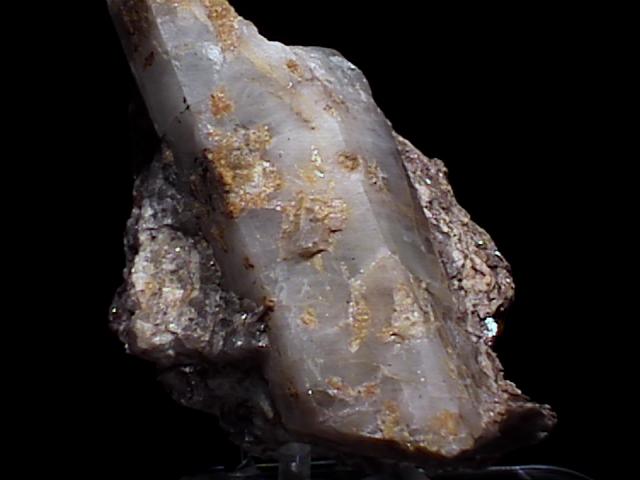
Harding District, Taos County, New Mexico, USA
A large beryl crystal lies on a host rock of quartz and polylitionite. The beryl crystal nearly spans the length of the specimen, and is over 3cm in width. It has a slightly distorted hexagonal cross section, is white, translucent, and has a slightly dulled but otherwise vitreous luster. There are other minerals (light brown and black) on the surface, giving the crystal a dirty appearance in places.
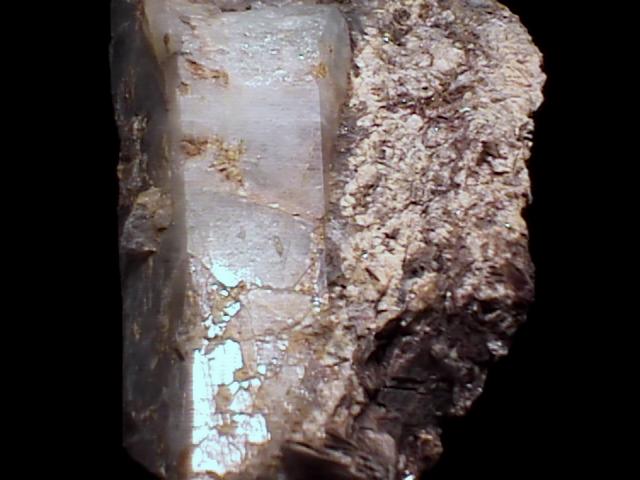
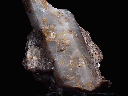
ber-28 ($ 40.00)
Harding District, Taos County, New Mexico, USA