WHY ARE
ASSOCIATED MINERALS IMPORTANT?
Minerals will often form in specific environments and be associated with specific minerals. Sometimes a mineral is only associated with a certain suite of minerals. Identification of these associated minerals can help in the identification of an unknown mineral. For instance, the phyllosilicate mineral apophyllite is typically associated with Zeolite Group minerals. It becomes diagnostic to find zeolites with a mineral that is suspected of being apophyllite and vice versa.
Not all possible associations can be mentioned for most minerals. But, in some cases a mineral may only be found with a few key minerals. Benitoite is one such example. It is found associated with only natrolite, neptunite and serpentine and a few other very rare minerals. In these cases, the associations can be one of the most important characteristics. Keep in mine that in most mineral descriptions only important or common associations are listed and the fact that a mineral is found in association with a mineral that was not mentioned should not be considered an error and don't discount the possible identity of the unknown mineral based on this alone. Remember these are only an aid to identification and not the only possible associations.
Mineral associations can be quite fun for the collector. In addition to a collection containing all the possible forms, colors, varieties, etc. of a mineral, it could also contain all the possible associations! Some mineral associations are quite interesting, beautiful and full of character. Often mineral collectors strive for certain classic mineral combinations. At times the attractiveness of an association is in its contrasting or complementary colors and at others it is just the unique character difference in the crystal forms and habits such as a dendritic gold specimen emerging from a marble-like quartz base. And hey! You often get more for your money when you can get two, three or four minerals in one specimen!
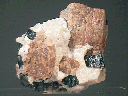 |
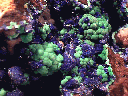 |
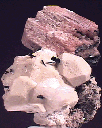 |
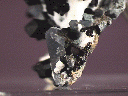 |
|
|
and Franklinite |
with Malachite |
with Serandite |
with Natrolite |
|
|
|
|
|
| |
|
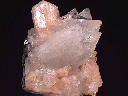
Apophyllite with Stilbite |
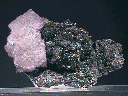
Fluorite with Sphalerite |
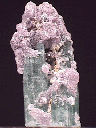
Elbaite |
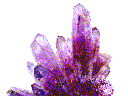
- Purple amethyst
with golden or colorless, crystal clear
calcite.
- Blue celestite with yellow
sulfur.
- Silver sulfide mineral clusters of
polybasite,
stephanite and
acanthite.
- Shiny black huebnerite with clear, colorless
quartz.
- Pink elbaite
(a tourmaline) with shiny lavender
lepidolite.
- Copper and
silver combinations.
- Silver
galena with yellow
anglesite and sparkling
cerussite.
- Green amazonite with
smoky quartz.
- Sky blue kinoite covered with tiny sparkling
apophyllite.
- Purple fluorite with shiny black
sphalerite and silver
galena (a personal favorite).
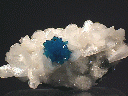
- Blue-green cavansite with white
stilbite.
- Brassy pyrite with
milky quartz.
- Golden brown barite on yellow
calcite.
- Green apatite in orange
calcite.
- Rounded red almandine garnet crystals in a matrix of sparkling black
biotite.
- Fibrous artinite on massive green
serpentine.
- Green and blue chrysocolla covered with sparkling drusy
quartz.
- Red ruby with green
zoisite.
- Green sparkling adamite
pearched on orange, earthy
limonite.
- Beautiful blue boleite with epitaxial growths of cumengite forming star shaped crystals.
 Amethyst Galleries' Mineral Gallery MINERALS |