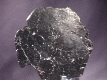
 THE MINERAL BIOTITE
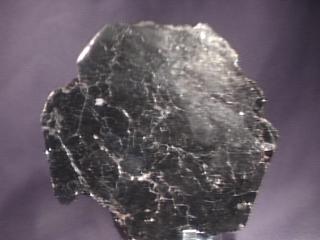
- Chemistry: K (Fe, Mg)3 AlSi3 O10 (F, OH)2, Potassium iron magnesium aluminum silicate hydroxide fluoride.
- Class: Silicates
- Subclass: Phyllosilicates
- Group: Micas
- Uses: heat insulator for industrial purposes.
Specimens
PHYSICAL CHARACTERISTICS:
- Color is black to brown and yellow with weathering.
- Luster is vitreous to pearly.
- Transparency crystals are transparent to translucent.
- Crystal System is monoclinic; 2/m
- Crystal Habits include tabular to prismatic crystals with a prominant pinacoid termination. Biotite's four prism faces and two pinacoid faces form pseudo-hexagonal crystal "books". The sides of the crystal often tend to tapper and can have a "hard candy that has been sucked on, look". Also as lamellar or granular rock forming masses providing the luster for most schists and gneiss.
- Cleavage is perfect in one direction producing thin sheets or flakes.
- Fracture is not readily observed due to cleavage but is uneven.
- Hardness is 2.5.
- Specific Gravity is approximately 2.9 - 3.4+ (slightly above average)
- Streak is white.
- Associated Minerals are quartz, feldspars, apatite, calcite, hornblende, garnets and schorl.
- Other Characteristics: cleavage sheets are flexible and elastic, meaning they can be bent and will flex back to original shape.
- Notable Occurrences include Bancroft and sudbury, Ontario; Sicily; Russia and many other locallities around the world.
- Best Field Indicators are crystal habit, color, cleavage, elastic sheets and associations.
 Amethyst Galleries' Mineral Gallery MINERALS |
BIOTITE specimen bio-1
$ 60.00
$ 60.00
Dims: 2.5" x 2.1" x 0.9"(6.4 x 5.3 x 2.3 cm)
Wt: 3.57 oz.(101.2 g)
northern Portugal
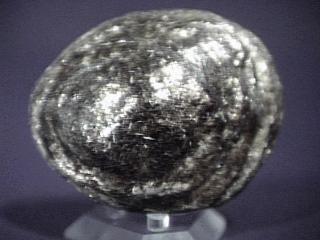
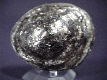
If I didn't know any better, I would swear that this specimen was actually a clam shell! This Biotite specimen is one of the weirdest that I have ever seen. It shows no hexagonal crystal form whatsoever, and has no straight edges or faces on it. It is shaped like a flattened, round nodule and has the black-brown color, pearly luster, and flaky, micaceous tendencies that one would expect from Biotite. The cleavage plane is aligned so that the flattest surfaces of the nodule correspond with what would be a crystal's basal faces. There appear to be tiny slivers of albite on both of these faces. If you have more knowledge of this type of Biotite specimen than I do, please write me and tell me about it, particularly details about its formation.
bio-1 ($ 60.00)
northern Portugal
BIOTITE specimen bio-2
$ 33.00
$ 33.00
Dims: 6.0" x 5.6" x 0.6" (15.2 x 14.2 x 1.5 cm)
Wt: 1 lb., 3.1 oz. (540 g)
Minas Gerais, Brazil
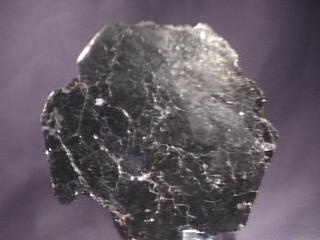
This particular piece is one of the largest Biotite specimens that I have seen. It consists of many thin, tabular Biotite sheets that are pressed together in a "book". Like most mica varieties, it has the flaky consistency and standard pearly luster of its group. Its color is black with brown highlights. Though it is not quite complete, one can still see a definite hexagonal shape to the book, and 2 of the sides are complete and rather well-defined. I think that this specimen is quite impressive.
bio-2 ($ 33.00)
Minas Gerais, Brazil
BIOTITE specimen bio-3
$ 45.00
$ 45.00
Dims: 1.8" x 1.2" x 1.0" (4.6 x 3.0 x 2.5 cm)
Wt: 1.3 oz. (36.6 g) w/ base
Lipscombe Deposit, Monmouth Township, Wiberforce, Ontario, Canada
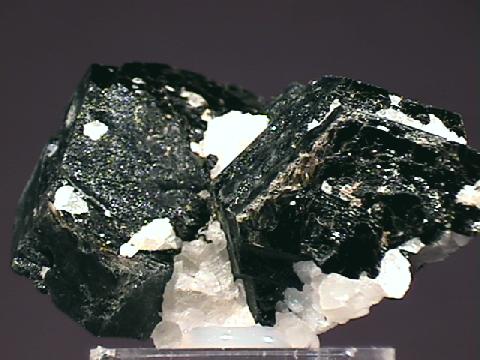
This thumbnail specimen consists of at least 3 partly-intergrown hexagonal "books" of Biotite mica. These books reach maximum dimensions of 1.0 x 0.8 x 0.6" (2.5 x 2.0 x 1.5 cm), and are all incomplete due to intergrowth with each other and with surrounding base rock, and due to a small amount of damage during the specimen's mining. Their pseudohexagonal form is excellent, however, with well-defined edges and clean faces that possess the classic pearly luster of mica. All have excellent basal cleavage and the flaky, "micaceous" consistency that is a hallmark of the micas. Their color is black with some brown highlights. Their base is made of white calcite that is crystalline but shows no definite form. The specimen is hot-glued onto an oblong acrylic base for display.
bio-3 ($ 45.00)
Lipscombe Deposit, Monmouth Township, Wiberforce, Ontario, Canada
BIOTITE specimen bio-4
$ 120.00
$ 120.00
Dims: 2.5 x 2.4 x 1.9" (6.4 x 6.1 x 4.8 cm)
Wt: 7.5 oz. (213.4 g)
Lipscombe Deposit, Monmouth Township, Wiberforce, Ontario, Canada
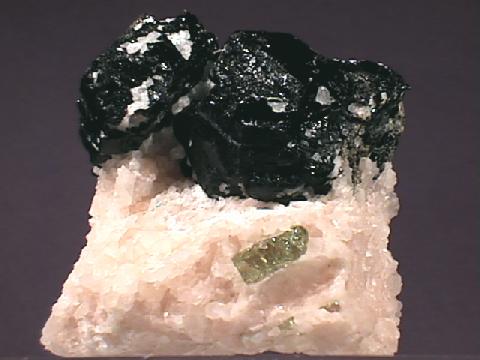
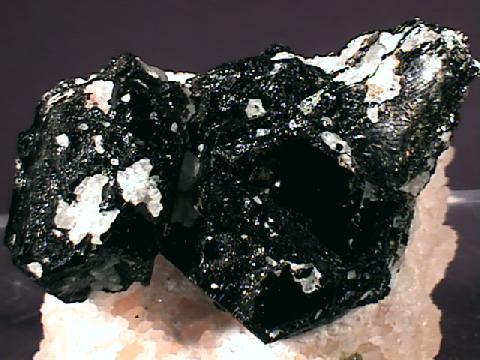
This small hand specimen consists of at least 3 thick "books" of hexagonal Biotite platelets. These books are in good condition, though two of them appear to have been cleaved, likely during the mining of the piece. They reach dimensions of 1.3 x 1.1 x 0.9" (3.3 x 2.8 x 2.3 cm) and show a definite hexagonal outline, though large portions of their prism faces are severely warped. Those portions that are not warped, however, are remarkably smooth and do not resemble the prism faces on most of the mica-group specimens that I have seen. They have the standard black coloration with some subtle brown highlights and the classic pearly luster on their cleaved faces- however, the intact faces possess a much duller, waxy luster. All are essentially opaque. The Biotite books rest on a base of semicrystalline calcite that glows a bright orange under UV light. Embedded in this calcite rest several pale yellow-green apatite crystals that are mostly incomplete and have a very warped hexagonal prismatic form. They are transparent and very clear, and possess a vitreous luster.
bio-4 ($120.00)
Lipscombe Deposit, Monmouth Township, Wiberforce, Ontario, Canada
BIOTITE specimen bio-5
$ 95.00
$ 95.00
Dims: 6.2 x 5.3 x 3.9" (15.7 x 13.5 x 9.9 cm)
Wt: 3 lbs., 6.4 oz. (1.542 kg)
Bancroft, Ontario, Canada
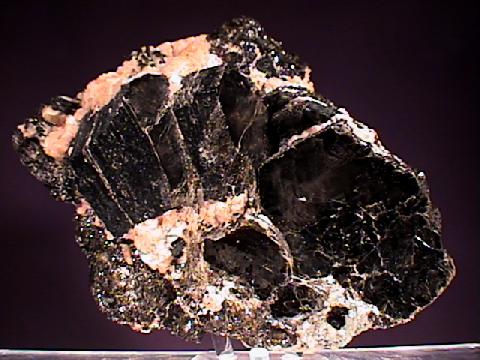
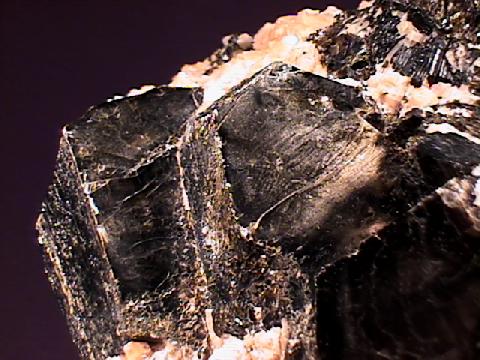
This cabinet specimen consists of at least 10 pseudohexagonal "books" of Biotite mica that are partly embedded in a calcite host. Most of these books are intergrown with each other and with masses of specular Biotite that make up a large percentage of the piece. The Biotite books are in good condition, though the largest one is damaged, and reach dimensions of 2.9 x 2.3" (7.4 x 6.6 cm). All but the largest have reasonably good form, with moderately well-defined edges and clean faces that possess the classic micaceous, pearly luster. They also possess the standard black color with golden highlights, and are essentially opaque at their present thicknesses. The pale-orange calcite host is noticeably sparse, and shows definite crystalline tendencies, if not any actual rhombohedral form. It is milky and translucent, and has a dull pearly-to-waxy luster.
bio-5 ($ 95.00)
Bancroft, Ontario, Canada
BIOTITE specimen bio-6
$ 40.00
$ 40.00
Dims: 3.5 x 3.2 x 2.2" (8.9 x 8.1 x 5.6 cm)
Wt: 12.5 oz. (353 g)
Bancroft, Ontario, Canada
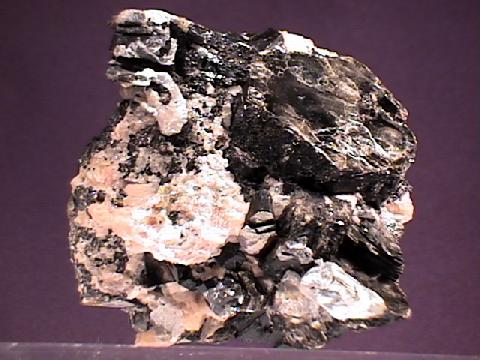
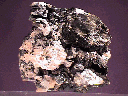
At least 10 "books" of pseudohexagonal biotite crystals make up a large part of this specimen. These crystals range in diameter from 0.5" (1.3 cm) to 1.8" (4.6 cm) and are generally in very good condition, as damage is sparse. Their forms are slightly warped due to intergrowth but are still very good, with moderately well-defined edges and smooth basal faces that possess the classic pearly luster. Their color ranges from a dark, silvery gray to black, and all of the books are essentially opaque in their present state. They are accompanied by a substantial amount of broken, crystalline calcite whose pale orange color is common for this locality.
bio-6 ($ 40.00)
Bancroft, Ontario, Canada
BIOTITE specimen bio-7
$ 30.00
$ 30.00
Dims: 4.5 x 3.6 x 2.5" (11.4 x 9.1 x 6.3 cm)
Wt: 1 lb., 11.0 oz. (765 g)
Bancroft, Ontario, Canada
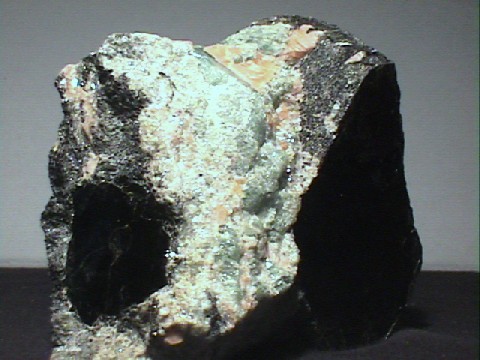
Three Biotite "books" are embedded in the base of this large cabinet piece. Both are in excellent condition, showing little damage. The largest of these books has visible dimensions of 3.5 x 1.7 x 1.6" (8.8 x 4.3 x 4.0 cm), and the others are less than half its size and far less exposed. This large book has a rather warped and incomplete pseudohexagonal form- the smaller crystals show much better form. All have the standard black color and pearly luster and are completely opaque. Their host rock appears to be made up of a layer of Biotite schist and a layer of tightly intergrown green apatites in a sparse orange calcite matrix; these apatite crystals are mostly broken.
bio-7 ($ 30.00)
Bancroft, Ontario, Canada