 THE MINERAL VARISCITE
- Chemistry: AlPO4-2H2O, Hydrated Aluminum Phosphate
- Class: Phosphates
- Group: Variscite
- Uses: mineral specimens and ornamental stone applications
Specimens
PHYSICAL CHARACTERISTICS:
- Color is light green to emerald green, sometimes bluish-green or colorless.
- Luster is vitreous or waxy.
- Transparency specimens are translucent.
- Crystal System is orthorhombic; 2/m2/m2/m
- Crystal Habits include nodules, fine grain masses, and crusts.
- Cleavage is normally not applicable, but should be good in one direction, poor in another
- Fracture is conchoidal, splintery, uneven.
- Hardness is variable from 3.5 - 5
- Specific Gravity is approximately 2.57 (average)
- Streak is white.
- Associated Minerals are apatite,
limonite, chalcedony,
crandallite , wardite and other secondary phosphate minerals. - Other Characteristics: alteration to other phosphate minerals causes a shrinkage, yielding gaps between variscite and these other minerals.
- Notable Occurances include Fairfield, Utah; Germany; Australia and Brazil.
- Best Field Indicators are color, habit, associations, density and luster.
 Amethyst Galleries' Mineral Gallery MINERALS |
VARISCITE specimen var-1
$ 25.00
$ 25.00
Dims: 6" x 4-1/4" x 2-5/8"
Wt: 1 lb., 5 oz
Utah, U.S.A.
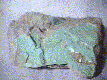
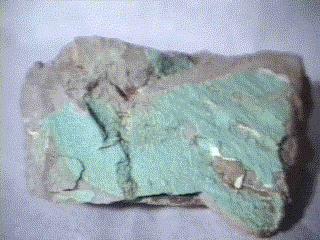
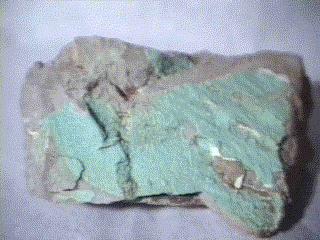
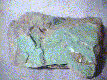
A thin, pale green crust of Variscite coats a matrix rock that looks a lot like a pale brown shale on this specimen. The crust is extremely thin(1 mm or so), but covers a generous surface area on its host. It exhibits noticeable botryoidal lumping throughout its expanse. I consider Variscite to be a rather strange mineral- its occurrence and formations just seem unique, in a way.
var-1 ($ 25.00)
Utah, U.S.A.
 VARISCITE specimen var-2
$ 120.00
Dims: 4.5" x 3.1" x 0.4" (11.4 x 7.9 x 1.0 cm)
Wt: 5.69 oz. (161.4 g)
Fairfield, Utah, U.S.A.
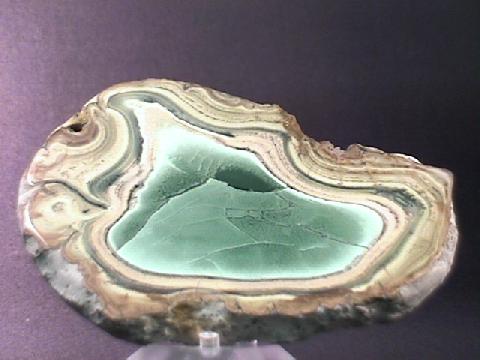
This specimen consists of a large slab of massive Variscite, one side of which has been polished. Its color ranges from a dull golden-yellow to a moderately deep green, and the patterns that it forms are reminiscent of those of a banded agate geode. The green "core" of the slab appears to have been broken at one time and possibly glued back into place. The backside of the slab has not been polished and is not quite ground flat and smooth. A few small pieces of the green core have been broken out of the slab. This is the largest piece of Variscite that I have seen in my travels- as I have not seen very many of these specimens, I can only assume that they are rather uncommon.
 var-2 ($120.00)
Fairfield, Utah, U.S.A.
VARISCITE specimen var-3
$ 67.00
$ 67.00
Dims: 3.2 x 1.9 x 0.8" (8.0 x 4.8 x 2.0 cm)
Wt: 2.9 oz. (83 g)
Box Elder County, Utah, U.S.A.
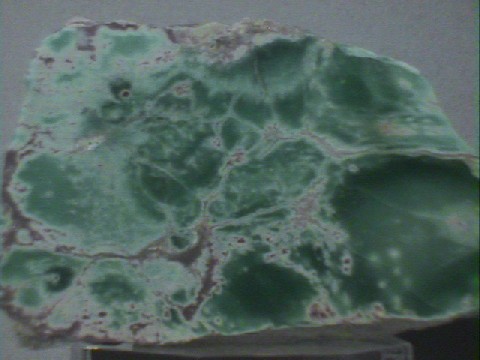
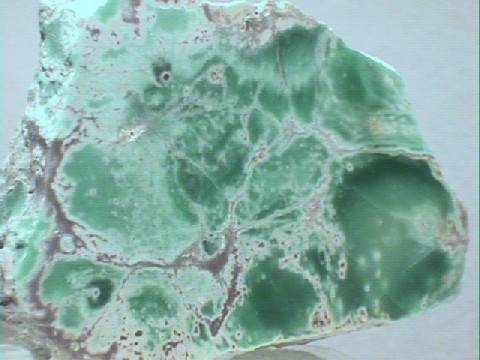
A partly polished chunk of massive Variscite makes up this small cabinet piece. This material has no crystalline structure and a color that ranges from pale to deep emerald-green. The one cut surface on the piece shows a moderately good polish, but the rest of the material is dull and earthy in luster.
var-3 ($ 67.00)
Box Elder County, Utah, U.S.A.
VARISCITE specimen var-4
$ 75.00
$ 75.00
Dims: 3.9 x 2.4 x 1.6" (10.0 x 6.1 x 4.0 cm)
Wt: 6.3 oz. (178 g)
Box Elder County, Utah, U.S.A.
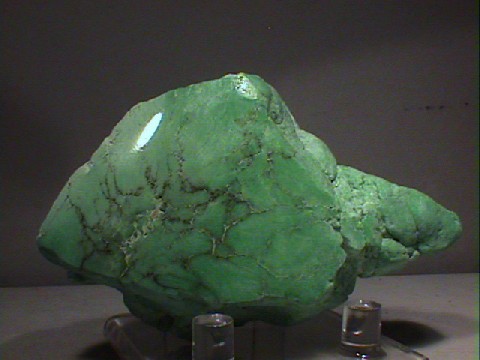
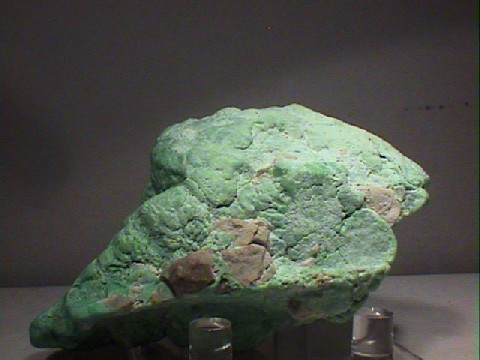
This cabinet piece consists almost entirely of a chunk of massive Variscite. Given its massive form, a damage and crystal habit assessment do not apply. It has the classic pale green color and dull luster, but a few areas show a dim sparkle that suggest perhaps some microcrystalline tendencies. One rather flat surface has been cut into the piece and polished to a high gloss. A few bits of pale gray rock are embedded in one area.
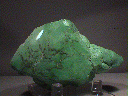
var-4 ($ 75.00)
Box Elder County, Utah, U.S.A.
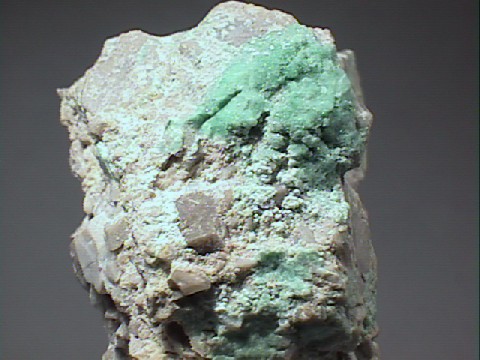
VARISCITE specimen var-6
$ 25.00
$ 25.00
Dims:1.7x1.3x1.2" (4.3x3.3x3.0 cm)
Wt: 1.8oz. (50g)
Lucin, Box Elder cty., Utah
This specimen consists of a microcrystalline mass of variscite. The tip of the specimen shows a multitude of miniscule crystals; even with a loupe, they are too small to effectively study. The specimen has the appearance of many nodules of variscite trapped in a variscite-rich matrix material.
var-6 ($ 25.00)
Lucin, Box Elder cty., Utah
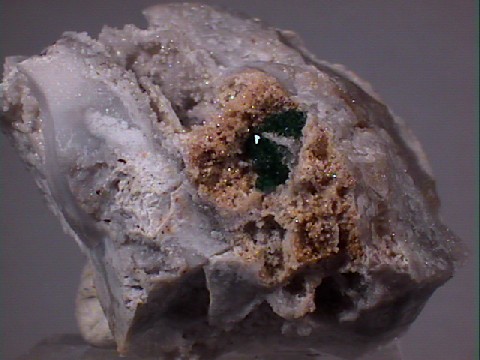
VARISCITE specimen var-5
$ 25.00
$ 25.00
Dims:1.5x1.2x1.0" (3.8x3.0x2.5 cm)
Wt: 1.8oz. (51g)
Itumbiara, Goias, Brazil
The matrix of this specimen holds a small vug of emerald-green variscite crystals. Upon examination with a loupe, these crystals are seen to be pyramidal in form. This is some of the best variscite crystals I have seen to date. They are entirely undamaged.
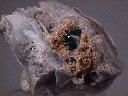
var-5 ($ 25.00)
Itumbiara, Goias, Brazil