 THE MINERAL DIABOLEITE
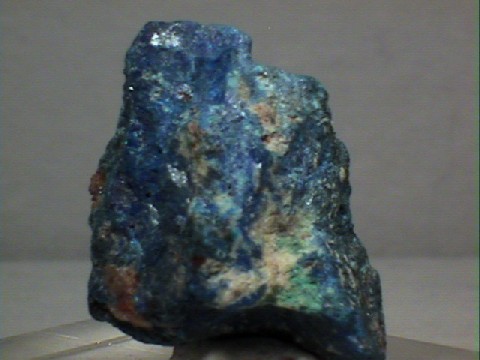
- Chemistry: CuPb2Cl2(OH)4, Hydrated Copper Lead Chloride Hydroxide.
- Class: Halides
- Uses: A very minor ore of copper and lead and as mineral specimens.
Specimens
Diaboleite's name could be interpreted from Greek as the "different" boleite. Not to be confused with the "false" boleite; named pseudoboleite. All three minerals have similar color and chemistries although boleite's is more complex and includes silver (Pb26Cu24Ag10Cl62(OH) 48 - 3H2O). Boleite was named for Boleo, Santa Rosalia, Baja California, Mexico. Diaboleite is only known from Mendip Hills, Somerset, England and a couple of localities in Arizona.
These three minerals and others with similar chemistries belong to a division in the
Halides Class called the
Oxyhalides and Hydroxyhalides.
These minerals have oxygen and/or hydroxide groups in their respective formulas.
The oxygen atom in the formula might require classification in the
Oxides Class of minerals except that the structures are more tied to the halide elements and the oxygens and hydroxides are kind of superfluous to the overall structure.
Some other members of the Oxyhalides and Hydroxyhalides include
bideauxite,
PHYSICAL CHARACTERISTICS:
- Color is sky blue to dark blue.
- Luster is adamantine.
- Transparency: Crystals are usually translucent to transparent.
- Crystal System is tetragonal; bar 4 2/m
- Crystal Habits include granular crystals and encrustations.
- Cleavage is perfect.
- Fracture is conchoidal.
- Hardness is 2.5
- Specific Gravity is 5.4 - 5.5 (very heavy for translucent minerals)
- Streak is blue.
- Associated Minerals include other copper and lead minerals such as boleite, linarite, anglesite, wulfenite, phosgenite and cerussite.
- Notable Occurrences are limited to the Mammoth-St. Anthony and Rowley Mines of Arizona, USA and the type locality of Higher Pitts Mine, Mendip Hills, Somerset, England.
- Best Field Indicators are color, density, fracture, streak and locality.
 Amethyst Galleries' Mineral Gallery MINERALS |
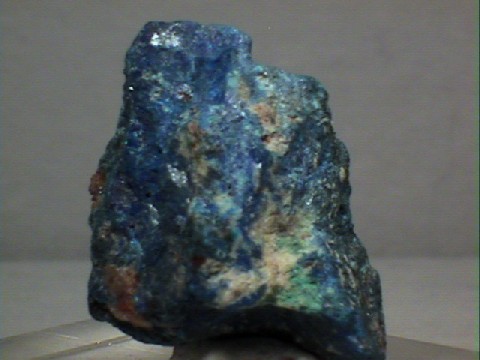
$ 60.00

dbl-1 ($ 60.00)

$ 100.00

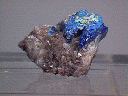
dbl-2 ($100.00)