 THE MINERAL POLYLITHIONITE
- Chemistry: KLi2AlSi4O10F2, Potassium Lithium Aluminum Silicate Fluoride.
- Class: Silicates
- Subclass: Phyllosilicates
- Group: Micas
- Division: True Micas
- Uses: Only as mineral specimens.
Specimens
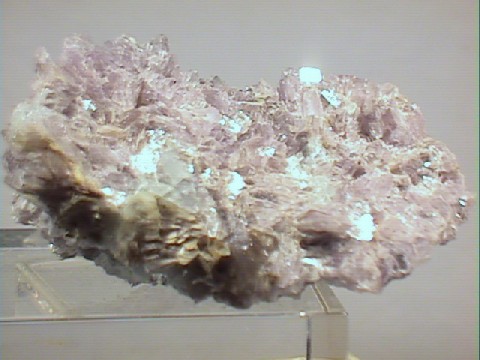
Polylithionite is certainly not one of the more well know mica minerals. It is a true mica closely related to other lithium rich micas; lepidolite and tainiolite. Polylithionite, like other micas, has a layered structure of lithium aluminum silicate sheets weakly bonded together by layers of potassium ions. These potassium ion layers produce the perfect cleavage. Polylithionite's rarity, associations with other rare minerals, attractive color and fluorescent color and crystal habit make it an ideal collection mineral.
PHYSICAL CHARACTERISTICS:
- Color is colorless, white, bluish, greenish, yellow, brown, pink, silvery to pearly white.
- Luster is pearly to waxy.
- Transparency crystals are transparent to translucent.
- Crystal System is monoclinic; 2/m
- Crystal Habits include pseudohexagonal tabular to platy crystals forming "books" and rosettes.
- Cleavage is perfect in one direction producing thin sheets or flakes.
- Fracture is not readily observed due to cleavage but is uneven.
- Hardness is 2 - 3.
- Specific Gravity is approximately 2.6 - 2.8 (average)
- Streak is white.
- Other Characteristics: Specimens are fluorecent lemon yellow under shortwave UV light.
- Associated Minerals are many and include
catapleiite,
ilmenite,
behoite , titanite, aragonite, eudialyte,leucosphenite , fluorite, willemite, apophyllite, rhodochrosite,steacyite , leifite, sodalite, pyrochlore, calcite, sugilite, microcline, axinite, manganbabingtonite, galena,ancylite , natrolite, serandite, hilairite,sheldrickite andcalcioancylite . - Notable Occurrences include the type locality of Kangerdluarsuk, Ilimaussaq alkaline complex, Greenland as well as Langesundsfjord, Norway; Varutrask, Sweden; Washington Pass, Okanogan County, Washington; Landsman Camp, Graham County, Arizona and Point of Rocks, New Mexico, USA; Dara-i-Poiz Massif, Tadzhikistan and of course Mont Saint-Hilaire, Quebec, Canada.
- Best Field Indicators are crystal habit, fluorescence, color, cleavage, locality and associations.
 Amethyst Galleries' Mineral Gallery MINERALS |
POLYLITHIONITE specimen pth-1
$ 35.00
$ 35.00
Dims:1.7x1.0x0.7" (4.3x2.5x1.8 cm)
Wt: 0.8oz. (23g)
Varutrask, North Sweden
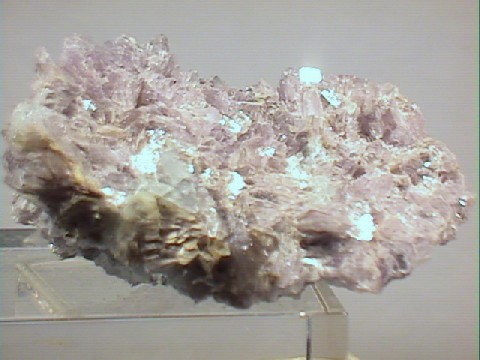
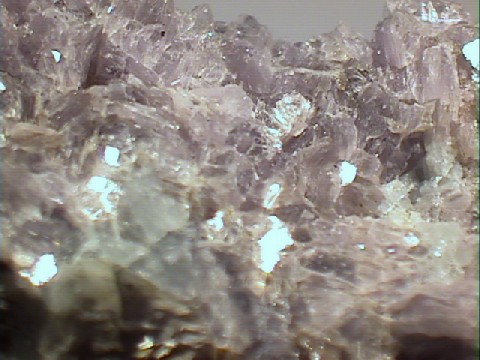
This specimen consists of hundreds of intergrown micaceous crystals of polylithionite. These crystals are silvery white in color, and so intergrown that the monoclinic form can not be determined. It is translucent around the edges where thinnest. There is some minor abrasion damage on some of the faces.
pth-1 ($ 35.00)
Varutrask, North Sweden
POLYLITHIONITE specimen pth-2
$ 68.00
$ 68.00
Dims: 1.3x1.5x1.4" (3.3x3.7x3.5 cm)
Wt: 0.6 oz. (18.0g)
Mt. St. Hilaire, Quebec, Canada
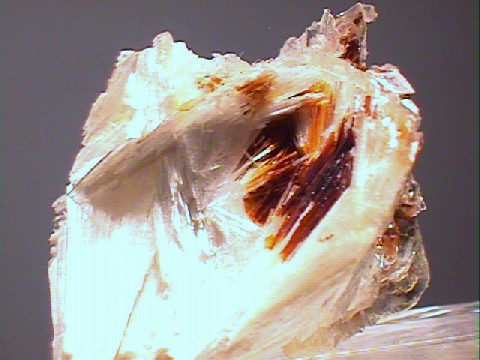
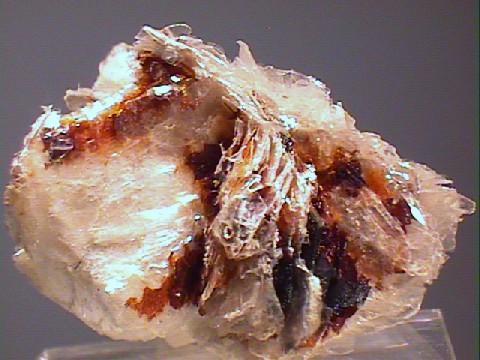
This small specimen consists of a clear colorless polylithionite mica in medium and large crystals perched upon a leifite base. The sheets of polylithionite are arranged in a flat rosette. It also fluoresces a sky blue color (not the usual lemon yellow) under short-wave UV. The leifite is in the form of a dense array of white acicular crystals, showing the proper lengthwise striations.
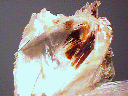
pth-2 ($ 68.00)
Mt. St. Hilaire, Quebec, Canada
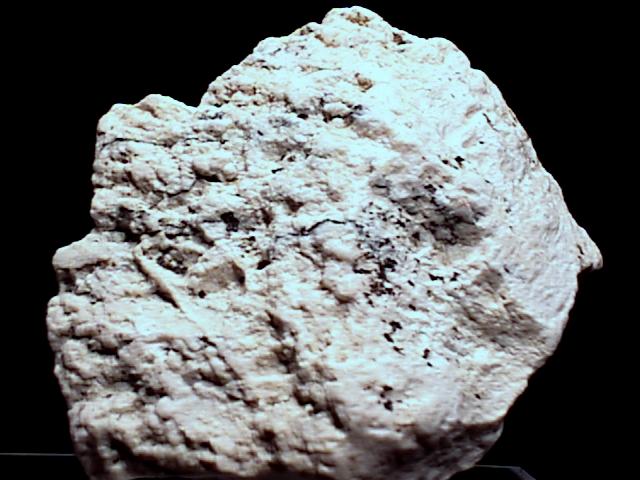
POLYLITHIONITE specimen pth-3
$ 25.00
$ 25.00
Dims: 1.70x1.60x1.57" (4.32x4.07x3.98cm)
Wt: 2.61oz (74.1g)
Khibiny, Russia
This is a largely featureless and non-descript specimen of polylithionite. It is microcrystalline, nearly massive, and has a nearly greasy feel (but not as greasy as talc). It takes a loupe to reveal any crystals, which do exist as tiny books of rounded plates forming small mammilary formations. Also in a loupe, some of the crystals show reflections from flat surfaces. There are other minerals present, including many dark areas, a dusting of brown crystals, a few spots of a green mineral, and some tiny quartz crystals. Over-all, this just looks like a chunk of a featureless rock, rather light for its size.
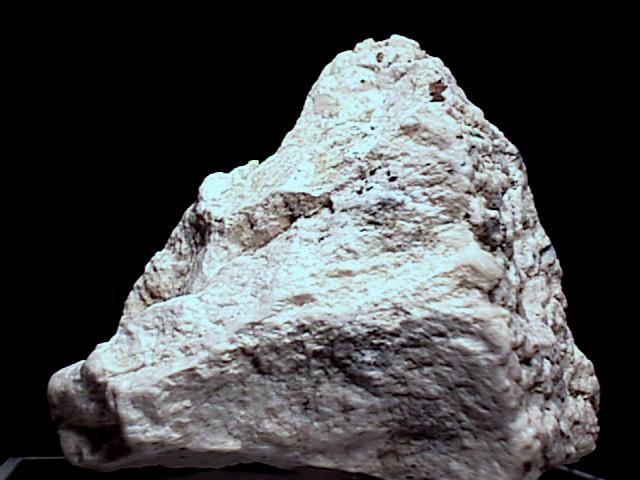
pth-3 ($ 25.00)
Khibiny, Russia